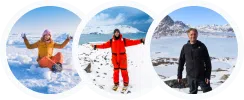
Adventures in Northeast Greenland: Glaciers, Fjords and the Northern Lights
Reykjav├нk - Reykjav├нk
Activities
Hiking
Lectures
Paddling Excursion
Polar Plunge
Sea Kayaking
Zodiac Cruises
Itinerary
Days 1-2
Reykjav├нk
Sprawling Reykjav├нk, the nation's nerve center and government seat, is home to half the island's population. On a bay overlooked by proud Mt. Esja (pronounced eh-shyuh), with its ever-changing hues, Reykjav├нk presents a colorful sight, its concrete houses painted in light colors and topped by vibrant red, blue, and green roofs. In contrast to the almost treeless countryside, Reykjav├нk has many tall, native birches, rowans, and willows, as well as imported aspen, pines, and spruces.Reykjav├нk's name comes from the Icelandic words for smoke, reykur, and bay, v├нk. In AD 874, Norseman Ing├│lfur Arnarson saw Iceland rising out of the misty sea and came ashore at a bay eerily shrouded with plumes of steam from nearby hot springs. Today most of the houses in Reykjav├нk are heated by near-boiling water from the hot springs. Natural heating avoids air pollution; there's no smoke around. You may notice, however, that the hot water brings a slight sulfur smell to the bathroom.Prices are easily on a par with other major European cities. A practical option is to purchase a Reykjav├нk City Card at the Tourist Information Center or at the Reykjav├нk Youth Hostel. This card permits unlimited bus usage and admission to any of the city's seven pools, the Family Park and Zoo, and city museums. The cards are valid for one (ISK 3,300), two (ISK 4,400), or three days (ISK 4,900), and they pay for themselves after three or four uses a day. Even lacking the City Card, paying admission (ISK 500, or ISK 250 for seniors and people with disabilities) to one of the city art museums (Hafnarh├║s, Kjarvalssta├░ir, or ├Бsmundarsafn) gets you free same-day admission to the other two.
Days 4-8
Northeast Greenland
Days 9-10
Cruising Denmark Strait
Day 11
Reykjav├нk
Sprawling Reykjav├нk, the nation's nerve center and government seat, is home to half the island's population. On a bay overlooked by proud Mt. Esja (pronounced eh-shyuh), with its ever-changing hues, Reykjav├нk presents a colorful sight, its concrete houses painted in light colors and topped by vibrant red, blue, and green roofs. In contrast to the almost treeless countryside, Reykjav├нk has many tall, native birches, rowans, and willows, as well as imported aspen, pines, and spruces.Reykjav├нk's name comes from the Icelandic words for smoke, reykur, and bay, v├нk. In AD 874, Norseman Ing├│lfur Arnarson saw Iceland rising out of the misty sea and came ashore at a bay eerily shrouded with plumes of steam from nearby hot springs. Today most of the houses in Reykjav├нk are heated by near-boiling water from the hot springs. Natural heating avoids air pollution; there's no smoke around. You may notice, however, that the hot water brings a slight sulfur smell to the bathroom.Prices are easily on a par with other major European cities. A practical option is to purchase a Reykjav├нk City Card at the Tourist Information Center or at the Reykjav├нk Youth Hostel. This card permits unlimited bus usage and admission to any of the city's seven pools, the Family Park and Zoo, and city museums. The cards are valid for one (ISK 3,300), two (ISK 4,400), or three days (ISK 4,900), and they pay for themselves after three or four uses a day. Even lacking the City Card, paying admission (ISK 500, or ISK 250 for seniors and people with disabilities) to one of the city art museums (Hafnarh├║s, Kjarvalssta├░ir, or ├Бsmundarsafn) gets you free same-day admission to the other two.
Map
Need advice?
No hard sell. Just excellent advice.
And Penguins.
- Guaranteed Best Operator Price
- 100% Financial Protection
- Free Travel Advice and Support
The Ship
Choose Your Cabin
Deck Plan