- Alkefjellet is an extensive, kilometer long bird cliff with steep ledges located on the west coast of Spitsbergen on the Hinlopen Strait.
- It is one of the largest Arctic seabird colonies with over 60,000 pairs of Brünnich’s guillemots (thick-billed murres) nesting on its ledges.
- The basalt cliff is composed of columns that date back 130 million years to the Jurassic period and rise to over 100 metres in height.
- Alkefjellet is rich in wildlife, with Arctic foxes and polar bears scavenging the cliffs for fallen eggs. Keep your eyes open for other birds, including kittiwakes and little auks.
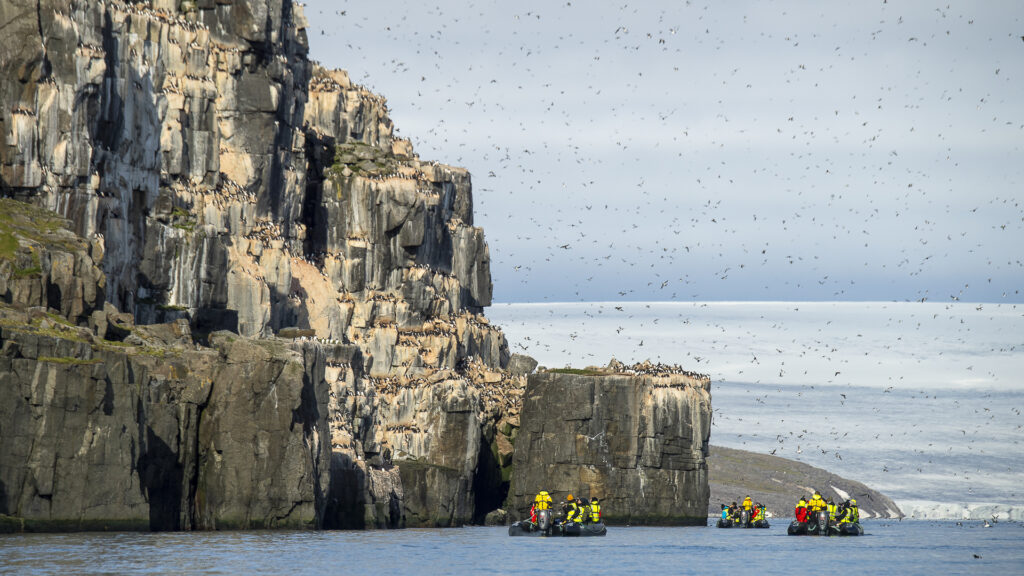
- A Zodiac cruise is the best way to get up close to the cliffs and observe the behaviour of the birds.
About Alkefjellet
Alkefjellet translates as “Auk Mountain” in Norwegian and is one of Svalbard’s most famous natural landmarks. As you approach the towering cliffs by Zodiac, you can hear the birds before you can see them. During the breeding season, when the cliffs of Alkefjellet are at their peak of activity, the sound of the bird calls can stretch as far as 10km away, depending on the wind. The cliff acts as a natural amphitheatre.
For the cruise visitor, Alkefjellet is a highlight. It’s the nearest you can get to any bird cliff in Svalbard. Whilst expedition ships have to stay 500 meters away, Zodiacs can go right up to the cliff. It’s a great way to take in the sights and sounds of this spectacular limestone formation.
Where Is Alkefjellet?
Alkefjellet is located on Spitsbergen on the western side of the Hinlopen Strait at 79°36’N.
[map]
The bird cliff rises from the Arctic Ocean, separating Spitsbergen and Nordaustlandet islands. The cliff stretches for several kilometres along the coast and reaches 100 meters high at its highest point.
Alkefjellet is approximately 150 km north of Longyearbyen as the crow flies and is situated in the Northeast Svalbard Nature Reserve. The nutrient-rich waters of the Hinlopen Strait ecosystem support the massive seabird populations. The strait serves as a migration route for wildlife, and upwelling currents bring nutrient-rich waters that support abundant fish and whale populations. This creates the perfect conditions and has supported massive seabird colonies for thousands of years.
When to Visit Alkefjellet
The best time to visit Alkefjellet is from late June to early September when the Hinlopen Strait is open for expedition vessels. It is worth noting that before June, the strait can be impassable due to thick sea ice. If Alkefjellet is a must-see for you, we recommend taking a cruise in July or August. No matter which month you choose, it will be in the summer under the midnight sun.
Late June visits offer the advantage of seeing the courtship and early nesting behaviour. Birds are establishing territories and laying eggs, exhibiting different yet equally interesting behaviours. The downside is potentially more challenging ice conditions and cooler temperatures, with some areas of the strait still having ice floes.
In my experience, July is the best time to see Alkefjellet at its best. During this period, the thick-billed murre colony is in full swing as adult birds are feeding their chicks. The cliff face is a bustling city with birds arriving and departing on fishing trips. The cacophony of calls from thousands of birds is an experience like no other, audible from several kilometres away. July also has the best weather with temperatures from 2-8°C (36-46°F) and minimal ice in the strait.
August visits allow you to see fledglings as they prepare for their first flights to the ocean. This period also offers better chances of spotting polar bears as they patrol the base of the cliffs looking for fallen chicks and eggs, something I have been lucky enough to witness. Weather can be more variable during the late season, but ice conditions are usually at their best.
How to Get To Alkefjellet
The main way to get to Alkefjellet is by joining an expedition cruise departing from Longyearbyen, Svalbard’s main settlement. Cruises of 10-14 days aim to visit Alkefjellet, but guarantees are never given due to the unpredictable nature of sea ice and weather conditions. The ships are equipped with Zodiac landing craft to get up close to the cliffs and are led by an expert guide team.
To find out more, please see our Svalbard Cruises for the largest selection of ships and operators visiting Alkefjellet.
What to Expect Visiting Alkefjellet
What I enjoy most about visiting Alkefjellet is its distinctiveness from other sights in Svalbard. The dark limestone cliffs and their unique basalt formations are nothing like anything else in the Arctic. Mix that with one of the densest populations of birds, and you have quite a phenomenal sight to see.
It’s not possible to land at Alkefjellet as the cliffs are too steep and there is nowhere to step ashore. Instead, exploration is done on small boats, which offer an excellent opportunity to get up close to the cliffs.
Cruising along the base of the cliff with 60,000+ breeding pairs of thick-billed murres above you is an experience that cannot be put into words or photographs. Meltwater from the Odinjøkulen ice cap creates waterfalls that cascade down the cliffs during summer.
For photographers, don’t forget to bring a wide-angle lens to capture the dramatic cliffs in their full splendour.
Wildlife
The thick-billed murre (Uria lomvia), also known as Brünnich’s guillemot, is the dominant species on the cliff. These hardy seabirds, about the size of small ducks, nest in incredibly dense concentrations on narrow ledges in the basalt cliff face. Each breeding pair has a territory of just a few square centimetres, creating a vertical city where neighbours literally rub shoulders throughout the breeding season. Their black and white plumage is stunning against the dark volcanic rock.
The sound of Alkefjellet during peak season is incredible. The combined calls of tens of thousands of birds are deafening and can be heard from 5 to 10 kilometres away, depending on the wind. The air is filled with the constant movement of birds arriving and departing on fishing trips, a dynamic aerial ballet that is mesmerising. The smell of guano and fish fills the air, offering a genuine (if pungent) Arctic wilderness experience.
While murres are the stars of the show, Alkefjellet is home to other Arctic wildlife. Glaucous gulls patrol the colony edges, feeding on eggs and chicks. Black-legged kittiwakes nest on the more exposed parts of the cliff, adding to the chorus. Arctic foxes can be seen at the base of the cliffs, feeding on fallen eggs and chicks in a remarkable display of Arctic adaptation.
The base of Alkefjellet is an important foraging area for polar bears, especially during late summer when sea ice hunting becomes more challenging. Bears patrol the shoreline looking for fallen chicks, eggs and carrion, offering thrilling (though distant) viewing opportunities for expedition visitors. Arctic foxes hunt for fallen chicks or eggs on the gentler slopes between the cliffs and the glacier.
Facts About The Cliffs Of Alkefjellet
- The birds at Alkefjellet eat an estimated 11,000 tons of fish per year during the breeding season, mainly Arctic cod and polar cod.
- Thick-billed murres can recognise their exact nesting spot among thousands of identical-looking ledges. Parent birds can find their single chick on a steep cliff just a few centimetres wide after fishing trips. Scientists believe they use a combination of visual landmarks, calls and even scent to achieve this remarkable feat.
- Brünnich’s guillemots lay pyriform eggs that are shaped to prevent rolling off the cliffs.
- The rock formations at Alkefjellet contain fossils from the time of dinosaurs, including marine reptiles and ammonites that lived in the ancient seas that covered this area 130 million years ago.
- Murre chicks have one of the most dramatic transitions in nature – they jump from 100-meter high cliff ledges into the Arctic Ocean when they’re just 3 weeks old and can’t even fly properly. The father bird accompanies the chick on this terrifying jump and continues to care for it at sea for several more weeks.
- If Alkefjellet were a building, it would be a 30-story skyscraper entirely covered in residents. The population density on the cliff face during peak season is higher than Manhattan, with birds packed so tightly that each pair occupies less space than a doormat.
- The cliffs of Alkefjellet are formed from molten rock and doleritic intrusions from the Jurassic or early Cretaceous period.
- While summer visitors enjoy relatively mild conditions, Alkefjellet experiences winter temperatures as low as -30°C (-22°F) with howling Arctic winds. Yet some hardy Arctic foxes remain in the area year-round, surviving partly on cached food from the abundant summer months when bird eggs and chicks are available.
Will I see a Polar Bear at Alkefjellet?
The most likely time to see a polar bear at Alkefjellet is during August, which coincides with fledging chicks taking their first flights from the cliffs. Like anywhere in Svalbard, polar bear sightings can never be guaranteed, and you will need some luck on your side. Joining a longer cruise is the best way to maximise polar bear sightings throughout Svalbard.
Summary
- Alkefjellet is one of Svalbard’s must-see wildlife sights.
- The bird cliff located in the Hinlopen Strait is home to over 60,000 breeding pairs of thick-billed murres, making it one of the world’s largest seabird colonies.
- The best time to visit is late June to early September, with July being the peak season for wildlife and good weather.
- The 130-million-year-old basalt cliff formations add a striking appearance to the wildlife spectacle.
- Access to Alkefjellet is possible by joining a Svalbard expedition cruise departing from Longyearbyen.
- It’s not possible to land at Alkefjellet, and a Zodiac cruise is the best way to experience it.
Visit Alkefjellet With Polar Escapes
At Polar Escapes, we are experts in Svalbard travel and have visited Alkefjellet many times ourselves. If you need firsthand experience to help plan your trip, please don’t hesitate to contact us.